
THIS SITE IS IN 'PRE-LAUNCH' AND IS STILL UNDER CONSTRUCTION.
This is NOT a production-ready site (yet). Stay tuned.....
DEMOSPIEL
Helping Game DESIGNERS make better games through ample playtesting.
Helping the public test out games and give feedback that can get incorporated into the games themselves.
Helping the Publishers of games get better games to publish.
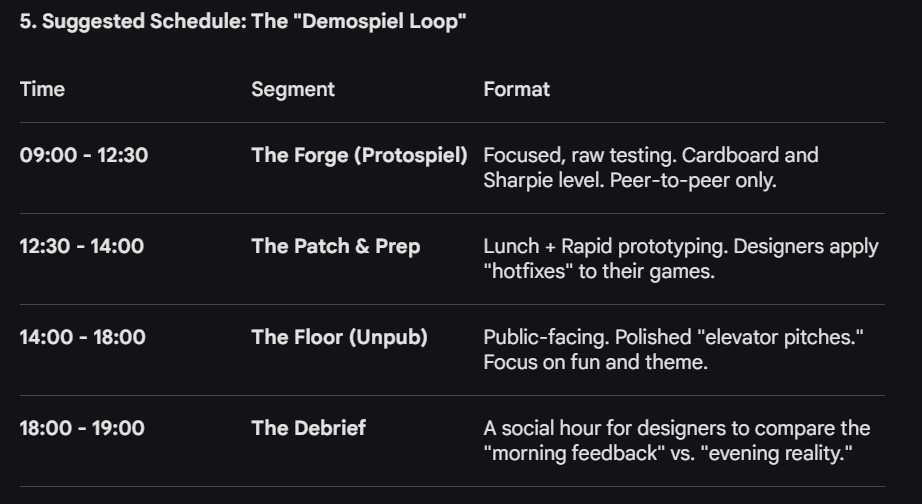
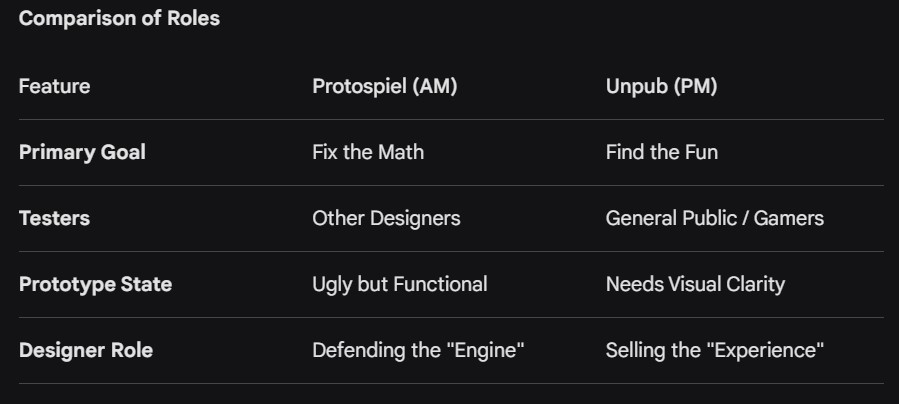
Combining the peer-review intensity of a Protospiel with the public-facing "showcase" of an Unpub into a single day is a powerful concept. It essentially creates a Rapid Iteration Lab.
Based on the mechanics of both events and the iterative nature of game design, here are the best practices I suggest for structuring your Demospiel:
1. The "Mid-Day Patch" (The Pivot Point)
The most critical part of your hybrid event isn't the sessions themselves, but the 90-minute gap between them.
The Workflow: After the morning Protospiel, designers shouldn't just eat lunch; they should have a "Stationery Bar" (cards, sharpies, stickers) available to physically "patch" the problems found by the designers before the public arrives.
The Goal: Show the public a better version of the game than the one the designers saw three hours prior.
2. Tailor the Feedback Tools
You need two different feedback forms because the two groups provide different types of value:
Morning (Designer Peer Review): Use "Mechanical Stress Test" forms. Ask about the "broken" parts: "Is the economy too tight?" "Did the catch-up mechanic work?" "What strategy felt unbeatable?"
Evening (Public/Unpub): Use "Emotional & UX" forms. Ask about the "feeling": "Was the rule explanation clear?" "What was your favorite moment?" "On a scale of 1-10, how likely are you to tell a friend about this?"
3. Tiered Participation (The "Beta" Badge)
Since you also do Mega Games, you can use the Demospiel to test specific modules of a large game:
Morning: Have 5 designers playtest just the Diplomacy or Combat subsystem of your 30-person game.
Evening: Run a "Vertical Slice" (a 30-minute high-energy demo) for the public to see if the spectacle of the Mega Game attracts a crowd.
4. Reciprocal "Designer Credit"
A core rule of Protospiels is that if you want people to play your game, you must play theirs.
Suggestion: Implement a "Token System." Designers earn tokens by playtesting others' games in the morning. They "spend" these tokens to secure a prime table/booth for the evening Unpub session. This ensures that everyone gets their mechanics vetted before they go "live."
Pages
The United States Tabletop Association (USTA) is organized exclusively for educational and charitable purposes.
Our mission is to advance the art and science of tabletop game design and to provide public education regarding the cognitive and social benefits of structured play.
© 2026 DemoSpiel - All Rights Reserved.